


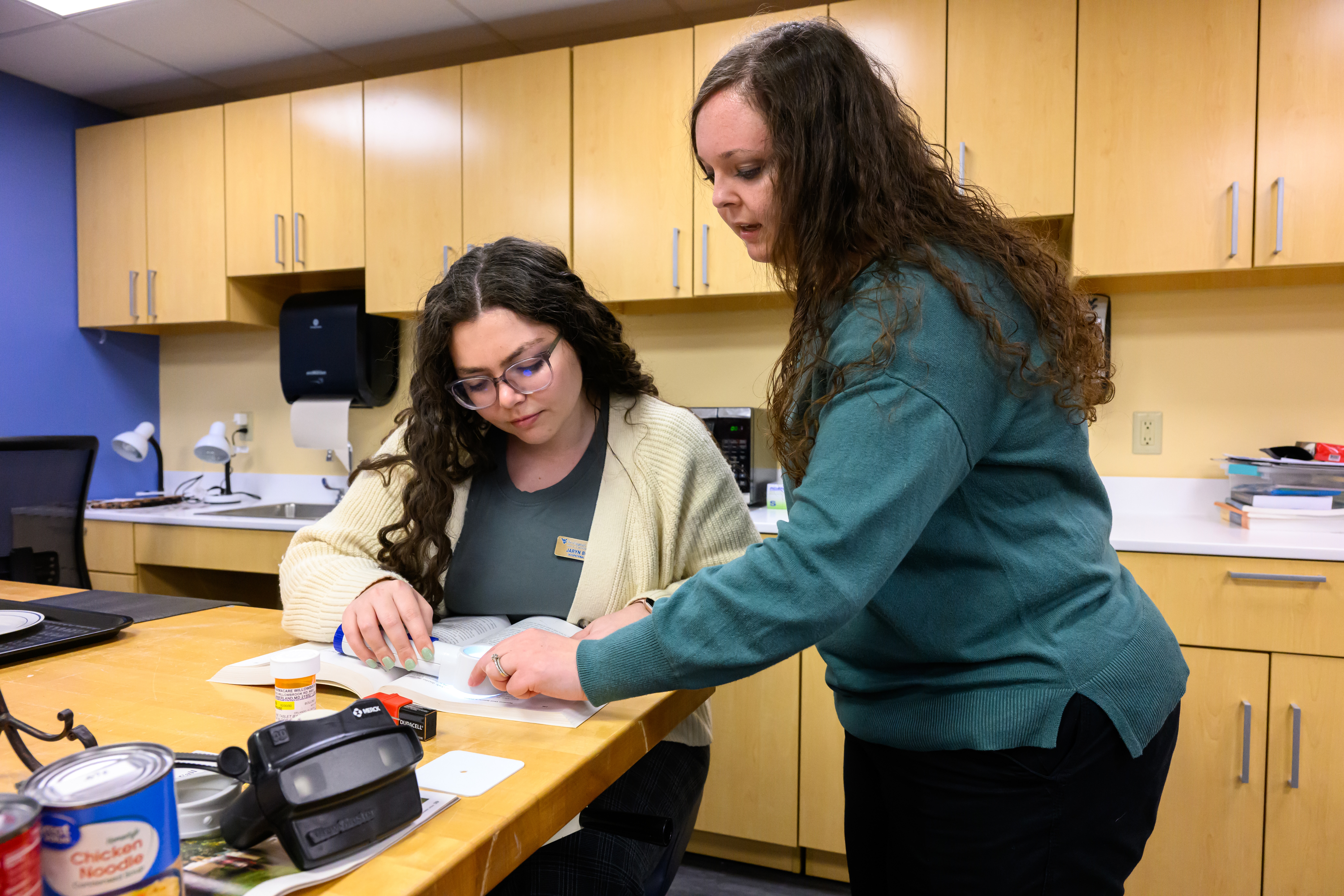
A West Virginia University occupational therapy student learns the technique of reading with a stand magnifier. Providing low vision modifications, such as using adaptive techniques and devices, is a common intervention in occupational therapy. (WVU Photo/Davidson Chan)
As part of May’s Healthy Vision Month, a West Virginia University expert is raising awareness about the effects of vision impairment experienced by more than 37 million adults in the United States.
Heather Livengood, assistant professor in the WVU School of Medicine Department of Occupational Therapy with specialty training in vision rehabilitation, is available to discuss how natural lighting and glare due to weather can influence the symptoms of eye diseases that limit vision. Livengood can also provide tips for preparing emergency kits for people with impaired vision.
Understanding the manifestations of macular degeneration, cataracts, diabetic retinopathy and glaucoma is important to those who have the diseases and their family members or caregivers, Livengood said.
Quotes:
“People with vision loss often see worse on cloudy or rainy days, and may experience decreased acuity and difficulty with contrast. However, on bright sunny days, they might see more clearly, but could have sensitivity to light.
“Visual acuity is the ability to clearly distinguish detail, color and shapes — for example, being able to read print on a sign. Contrast refers to the ability to detect the differences between items that are similar in color or differences in how bright an item looks compared to its background — for example, being able to distinguish steps, the sidewalk from the curb or identifying spilled water on a surface. This is typical for people with macular degeneration, diabetic retinopathy or cataracts.
“Light also becomes more scattered by clouds and rain, making the environment look flatter. This may cause people with vision loss to experience difficulty with depth perception, distinguishing between textures and reduced visual acuity at mid-range and longer distances.
“Sensitivity to light can refer to light/dark adaptation, the ability of the eyes to adjust to changing light levels, which can result in a sense that details are washed out and more difficult to see. For example, walking from dimly lit indoors to a very sunny day outdoors. When people look at light that is too bright for the eye to tolerate, the pupils will constrict, or become smaller, and less light will enter the eye. While this is a protective response, having less light enter the eye can significantly reduce functional vision.
“Another example of sensitivity to light is glare, the undesirable sensation that occurs when we look toward a light that is much brighter than what the eyes are used to — for example, the headlights of an oncoming vehicle when driving at night. Rain can also result in glare from wet surfaces such as pavement, puddles and car windshields by reflecting more light compared to dry surfaces.
“There are some simple, everyday items people can use to help minimize the effects of glare and to manage sensitivity to light. Wear hats or visors with brims to reduce the amount of glare that comes from overhead. Reducing glare may increase the ability to see items similar in color or with acuity. With the help of an eye care professional, identify whether a filter that can be worn or clipped onto eyeglasses would be useful. A yellow filter may be helpful in fog, rain or at dusk. A polarized brown lens may reduce glare from wet surfaces and improve contrast. Consider the use of a water-repellant spray for eyeglasses or device surfaces so water will roll off faster and potentially reduce blur.
“Taking time to move slower and use more deliberate actions such as moving the head in wider sweeps from side to side and using the eyes to scan can improve awareness of the environment.
“While preparing for emergencies is important for everyone, some special considerations should be implemented for people with visual impairment. Label supplies including flashlights, radios and medication bottles with tactile cues such as bump dots, rubber bands or Velcro dots. This will allow those with vision loss to rely on their sense of touch.
“Create and practice nonvisual evacuation routes by identifying tactile landmarks such as handrails, floor textures and turns. Memorize route counts by number of steps it takes to get to a door from a starting point, the number of doorways to pass and the number of turns.
“Establish multiple communication backups that do not rely on vision. For example, explore accessibility functions like phone screen readers. Place a remote-controlled audible device near an exit that can be activated in an emergency.
“Pre-register with local emergency services for accessibility accommodations. During an emergency, officials will be aware of special needs and be alerted to the greater risk of harm than someone without special needs.” — Heather Livengood, assistant professor, Department of Occupational Therapy, WVU School of Medicine
West Virginia University experts can provide commentary, insights and opinions on various news topics. Search for an expert by name, title, area of expertise or college/school/department in the Experts Database at WVUToday.
-WVU-
ls/5/4/26
MEDIA CONTACT: Linda
Skidmore
Health Research Writer
West Virginia University
Health Sciences
Linda.Skidmore@hsc.wvu.edu
Call 1-855-WVU-NEWS for the latest West Virginia University news and information from WVUToday.