


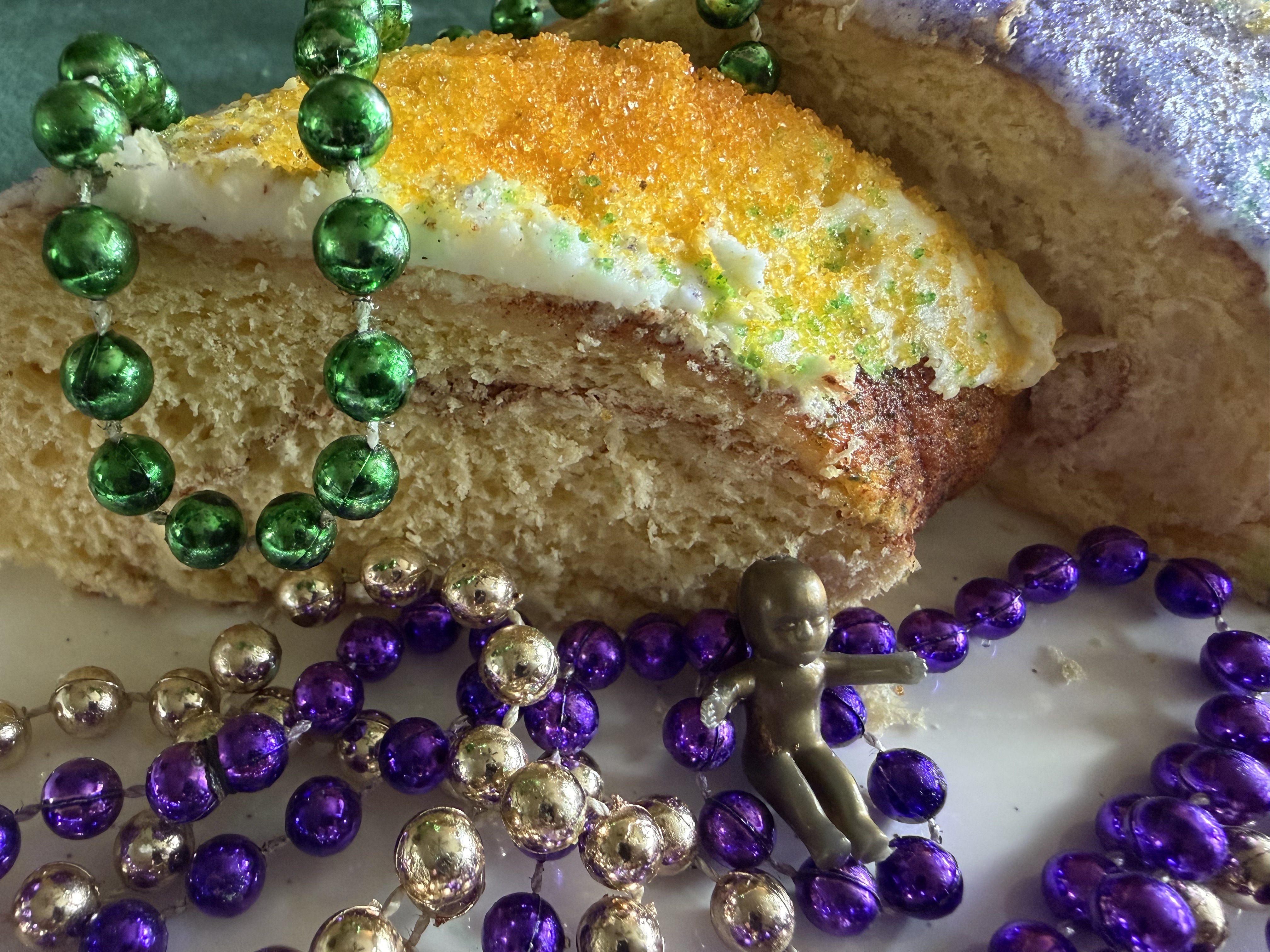
According to a WVU religious studies professor, the Mardi Gras tradition of eating king cakes dates back 900 years. (WVU Photo/Holly Leleux-Thubron)
As the world prepares to celebrate Mardi Gras (Feb. 17), a West Virginia University religious studies expert explains that while most Americans are familiar with the famous Mardi Gras floats and beads of New Orleans, global festivities take many forms, including a public food fight in Italy.
Aaron Gale, associate professor with the WVU Eberly College of Arts and Sciences, is available to discuss the origins and traditions of Mardi Gras and Carnival, including the significance of foods like king cake.
Quotes:
“Many people now use the terms ‘Mardi Gras’ and ‘Carnival’ interchangeably, as if they are the same thing. But Mardi Gras is a single day, while Carnival is an entire season of celebration.
“Carnival takes place from Epiphany on Jan. 6 — the ‘real’ end of the 12 days of Christmas — through Mardi Gras. The word ‘Carnival,’ which means ‘farewell to flesh,’ was named because it was a time of celebration that took place before Lent, during which the Catholic Church originally required that no meat be eaten.
“‘Mardi Gras’ is French for ‘Fat Tuesday,’ so-called because on the day before Ash Wednesday, when European countries like Poland, Germany and Italy customarily emptied their cupboards of gluttonous and fatty ingredients such as lard, eggs and butter. This was because many families refrained from eating such rich foods during Lent, a time of stark discipline.
“The Mardi Gras tradition of king cakes, typically round or oval, is likely 900 years old. One possibility is that the food’s roots lie in the ancient Roman festival of Saturnalia, in which a pretend king was chosen by a bean placed inside a sweet pastry. Once king cakes gained Christian footing throughout Europe, they became linked to the visit the three wise men, or ‘kings,’ paid to the baby Jesus on the 12th day of Christmas, 12 days after his birth. Today, king cakes are typically colored purple for justice, gold for power and green for faith. The custom of hiding something inside remains, except now one may find a little baby Jesus instead of a bean.
“Mardi Gras probably traveled to the United States via the French and was probably first celebrated in and around New Orleans in the 1700s, although not in exactly the same manner that we know today.
“For example, floats and parades were not always part of Mardi Gras celebrations. That happened in the 19th century. It’s likely that elegant balls were originally the main fare, with participants donning masks as a form of disguise. As Mardi Gras gained ground throughout the U.S., modern features — like flashing for beads — were added, for better or worse.
“Today, Mardi Gras and Carnival are celebrated together throughout the world. Spain, Brazil, Germany, Italy — all have their own unique celebrations. One of the most distinctive manners of revelry happens in Ivrea, Italy, where a medieval revolt against a tyrant is reenacted in the famous ‘Battle of the Oranges.’ It may just be the largest sanctioned food fight in the world.” — Aaron Gale, associate professor, religious studies, WVU Eberly College of Arts and Sciences
West Virginia University experts can provide commentary, insights and opinions on various news topics. Search for an expert by name, title, area of expertise or college/school/department in the Experts Database at WVUToday.
-WVU-
mm/2/13/26
MEDIA CONTACT: Rachel Brosky
Media Manager
WVU Strategic Communications and Marketing
304-293-3990, RaBrosky@mail.wvu.edu
Call 1-855-WVU-NEWS for the latest West Virginia University news and information from WVUToday.