WVU program assistant uses robotics engineering to inspire young minds
Annie Harmon, program assistant for the Department of Mechanical, Materials and Aerospace Engineering in the WVU Benjamin M. Statler College of Engineering and Mineral Resources, never dreamed she'd end up teaching, but after a string of seasonal teaching experiences, she discovered a passion for exposing young minds to the world of science. (WVU Photo/Brian Persinger)

Balls and Lego bricks may be toys, but for Annie Harmon, program assistant for the Department of Mechanical, Materials and Aerospace Engineering at the West Virginia University Benjamin M. Statler College of Engineering and Mineral Resources, they are a way to introduce kids to a new world: robotics engineering.
In Miss Annie’s classroom, kids as young as five are engineers, learning to program Sphero robots to play a new and improved version of hot potato and writing code to make their brick creations come to life.
“I want youth to get the opportunity to do some coding, some building and some design, so that they know what an engineer is and that it is an option for a really good career,” Harmon said.
Harmon was hired as the MMAE program assistant in 2024 to inspire young minds to explore STEM career paths. Each semester, she arranges for K-12 students across West Virginia to visit the Statler College, goes into local classrooms, and hosts events, such as the WVU Student Recreation Center’s Robotics Kids Night Out, all to help kids understand how fun engineering can be.
Annie Harmon brings K-12 students to the WVU Statler College and into hands-on STEM events across West Virginia. (WVU Photo/Brian Persinger)
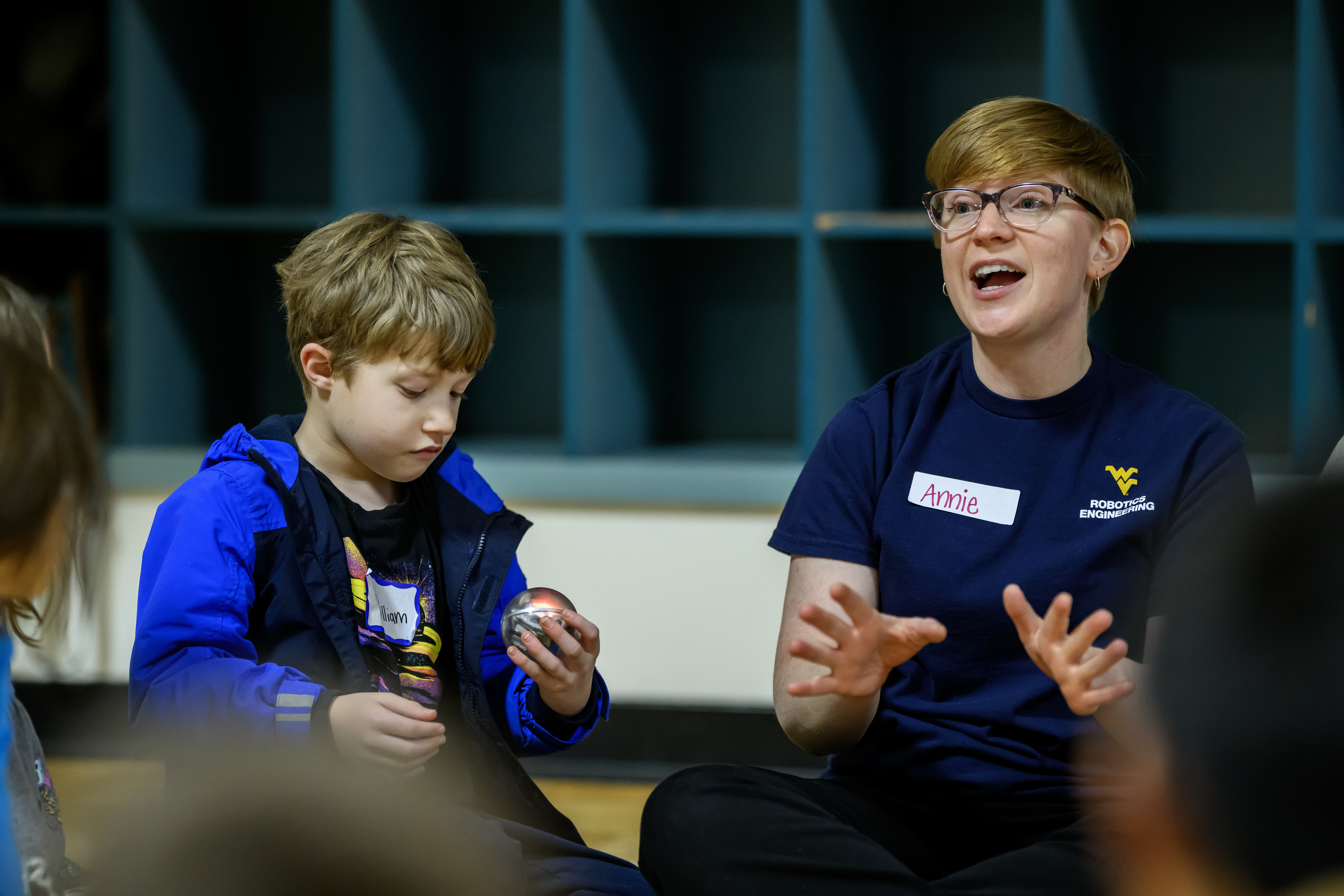
“I often tell kids, and this is true, that when I was growing up, I didn’t have a good concept of what engineering was,” Harmon said. “It’s kind of an abstract concept, so that is something we start with for all our outreach visits, especially the ones where they come to the Statler College. ‘What is an engineer?’ ‘What do they do?’ ‘What tools do they use?’”
Harmon did not originally see herself becoming a teacher or entering the engineering world. She grew up in Elkins before earning a bachelor’s degree in biology from Denison University. She first explored teaching as an assistant park naturalist for Blackwater Falls State Park. This led her on a string of seasonal teaching positions across the region, where she enjoyed exposing young minds to the scientific world.
Harmon returned to West Virginia to teach at the Science Adventure School, before joining Statler College in the program assistant position. Though she didn’t have a history with robotics engineering, Harmon’s fascination with the subject shines through as she speaks with her young pupils.
Balls and Lego bricks aren’t just toys in the programs that Annie Harmon organizes — they’re how kids learn robotics and engineering at WVU. (WVU Photo/Brian Persinger)
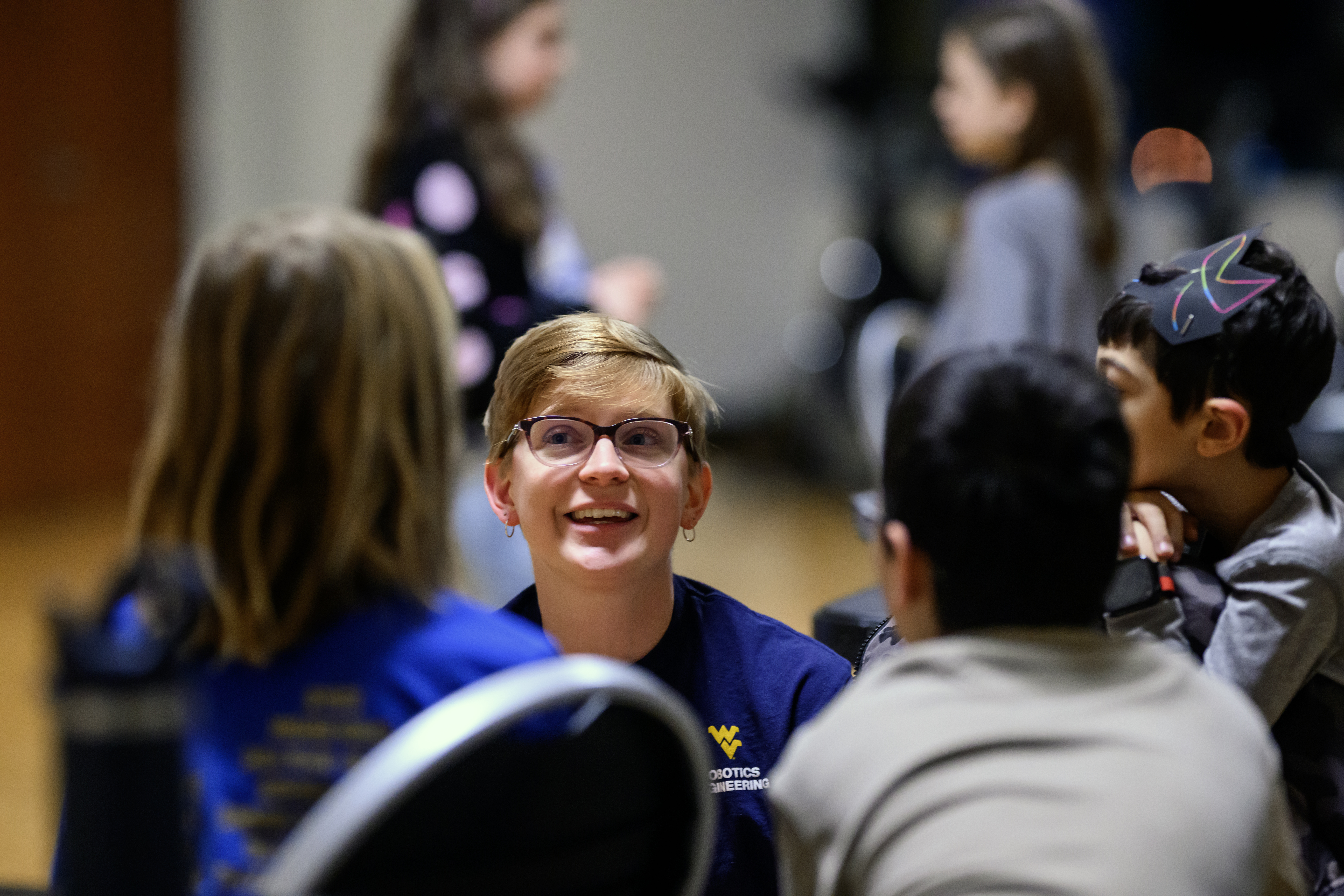
“My experience with robotics is pretty limited, which I’ve always thought was a strength. I’m approaching teaching, coding and engineering from a level that’s comfortable for our K-12 students. I’m able to interpret the language of robotics and science that can be really technical and put it into a context that a middle schooler can understand.”
Harmon’s teaching style challenges students to get creative and come to their own realizations, while staying within set parameters. This style often helps kids who are initially uninterested in the lesson begin exploring.
“Kids will surprise you,” Harmon said. “At a middle school, there was a girl sitting in the back and not very engaged with the lesson, adjusting her hair and makeup in her Chromebook. It was normal middle school behavior, but it does make you think it might be hard to get them involved. The lesson was to build and code a Lego robot that can race using a sensor. I kid you not, she and her partner won the race. Somewhere, between the lesson and race, it clicked, and she was adjusting her code and build and really getting into it.”
From Elkins to WVU, Harmon found her path through teaching — and now helps kids understand robotics in a way that clicks. (WVU Photo/Brian Persinger)
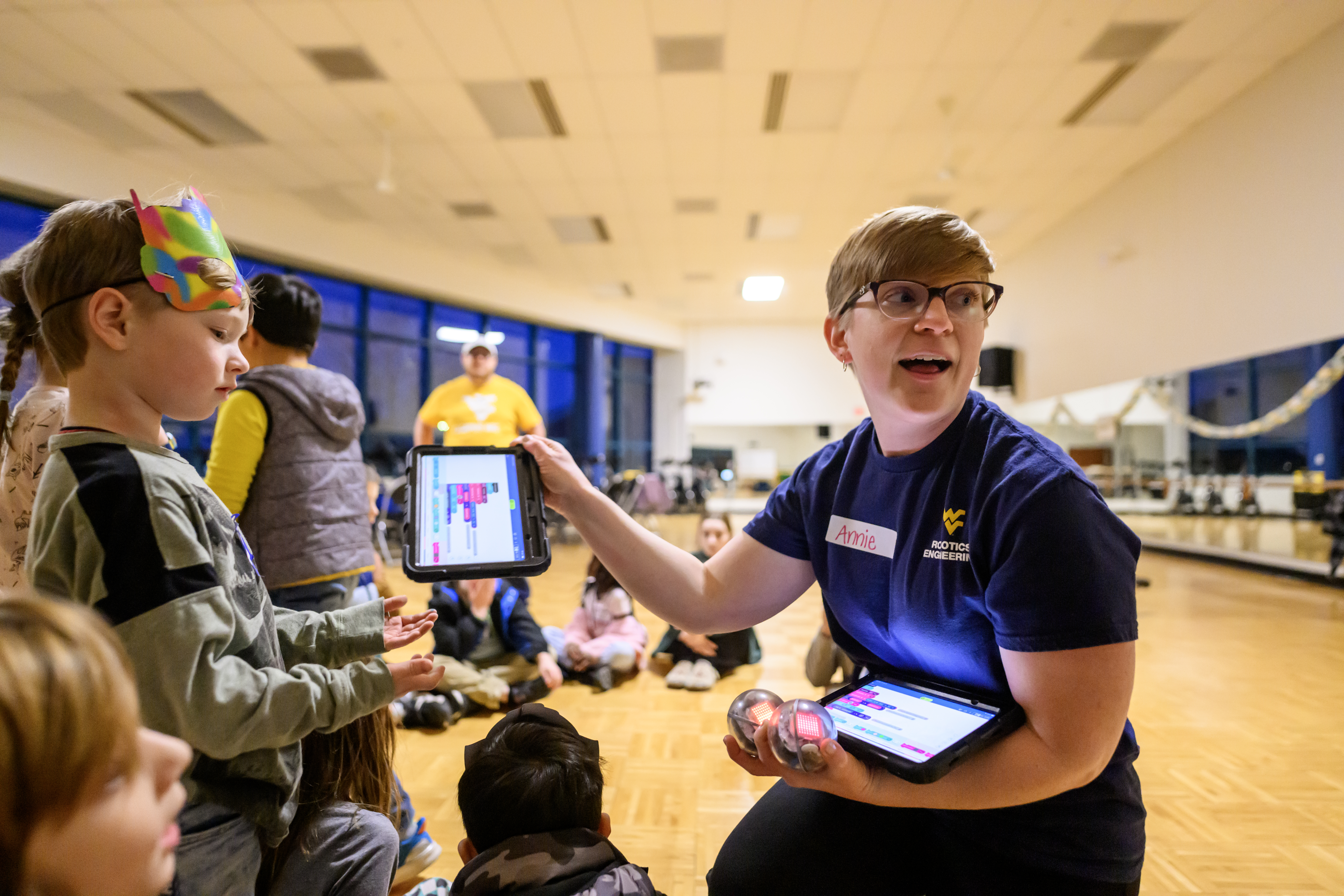
Similar situations were observed with the younger age group at Robotics Kids Night Out. Students who were originally uninterested in participating became Lego robotics experts by the end of the night. Harmon said coding combined with familiar toys and tools like building blocks, balls and drones helps kids discover what robotics and being an engineer is all about.
“When they’re on their screen coding, they’re focused on the technology, but the thing that will actually move when they press ‘go’ is a drone or a robot or a Lego creation that exists in the real world, and it is going to interact with the real world in sometimes unexpected ways,” Harmon said. “That makes it real and exciting for them.”
Harmon said she wants to give kids of all ages the ability to explore STEM, and that introducing engineering concepts helps build life skills outside of career exploration.
“I know that not all the kids I teach are going to study science, and that’s fine because my robotics activities are teaching good life skills, so-called ‘soft skills,’” Harmon said. “We’re working in teams, brainstorming, collaborating and persevering. When our first model doesn’t work, we’re changing it and testing it. We’re building life and social skills that make us into better people and better students for whatever it is that we end up studying. That’s what gets me excited.”
All of Harmon’s teaching programs are free, allowing students who may not otherwise have an opportunity to learn about robotics and engineering.
“It goes back to West Virginia University’s land-grant mission,” Harmon said. “We are both expected to and get the privilege of giving back to our community. We’ve got fantastic resources in terms of fancy robotics laboratories, and we want to make sure folks are aware of that. We want to throw the doors open wide as much as we can and welcome people in.”
Find more information about robotics engineering at WVU.
-WVU-