WVU innovation leader guides RETI coalition to power next generation of manufacturing
From neuroscience researcher to innovation leader, Erienne Olesh’s journey reflects the unexpected opportunities that define a WVU education. Today, she’s helping lead a nationally recognized effort to strengthen America’s energy future. (WVU Photo)

Five years.
That’s how long Erienne Olesh expected to stay in Morgantown when she arrived at West Virginia University to pursue a doctorate in neuroscience. She planned to earn her PhD and build a career researching treatments for stroke patients and concussions.
Instead, WVU gave her something she hadn’t anticipated — the opportunity to help shape the future of innovation in Appalachia.
Today, Olesh serves as CEO of the National Science Foundation’s Resilient Energy Technology and Infrastructure Consortium — RETI — a regional initiative led by WVU that includes Carnegie Mellon University, the University of Pittsburgh, and more than 60 public and private partners. Backed by up to $321 million in public and private investment over the next decade, the initiative aims to strengthen America’s energy future while building an innovation economy across Appalachia.
Erienne Olesh, CEO of the Resilient Energy Technology and Infrastructure Consortium led by WVU, and including Carnegie Mellon University, the University of Pittsburgh, and more than 60 public and private partners (WVU Photo)

It’s a role Olesh never envisioned when she came to Morgantown.
“I had a five-year plan,” she said with a laugh. “WVU and West Virginia kept me here by offering me one incredible opportunity after the next. I am still here and I’m so excited to be part of this next chapter.”
A departure from her initial career path, Olesh found herself drawn to innovation and commercialization, and helping researchers navigate the often-complex journey from scientific discovery to real-world impact. She’s served as the director of Vantage Ventures, as the executive director of Student and Faculty Innovation in the WVU Research Office, and as the executive director of the WVU Office of Innovation and Commercialization before being tapped to lead RETI as its CEO.
“Moving tech out of a research lab into markets is complex and dynamic,” she said. “It requires you to be able to work with faculty and researchers but also at the same time with business leaders. They speak very different languages, they have different values, and most of the time very different priorities. To be a successful navigator in this realm, you have to be able to translate and work among those groups to identify common ground and build consensus.”
RETI CEO Erienne Olesh, from right, WVU President Michael T. Benson, Beverly Wendland, WVU provost and vice president for academic affairs, and Christy Wyskiel, senior advisor to the president of Johns Hopkins University for innovation and entrepreneurship, pose for a group photo at a recent event in Washington, held to celebrate the NSF RETI announcement. (WVU Photo)
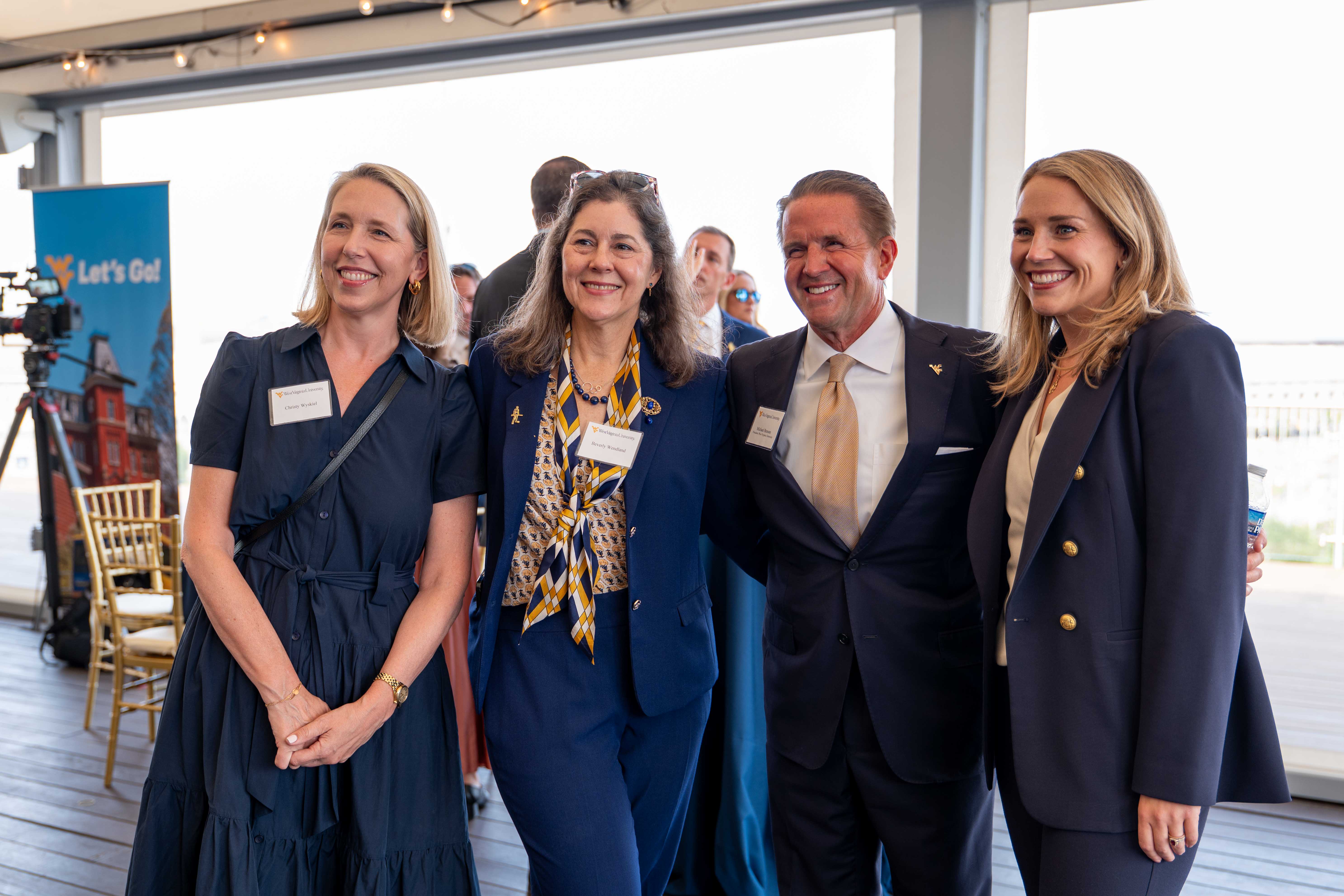
Her previous roles at WVU prepared her to lead RETI, where the same skills that helped connect researchers with entrepreneurs are now helping unite universities, industry, government, and workforce partners.
The journey to the final RETI announcement in July was a two-year competition cycle with more than its share of ups and downs, Olesh said. One of the defining moments to secure the Consortium came after a major ice storm in January forced the cancellation of a critical site visit to Morgantown just 48 hours before NSF reviewers were scheduled to arrive.
“We had 130 people scheduled to show up at this site visit, then got word from NSF that none of their site reviewers would be able to travel here because of the hazardous weather,” Olesh said. “We rallied and we rescheduled for March. Every single one of our partners showed up and the reviewers were so taken aback by the level of commitment they saw here. You could feel the excitement from NSF which felt very encouraging to me.”
For Olesh, that moment reinforced what makes RETI different.
“I have seen such an upswell of growth and momentum and opportunity in this space about what we’re doing in Morgantown and across the region,” she said. “The selection of WVU and this region for this Consortium is a really strong signal of external validation. A lot of people still don’t even know what’s going on here yet and we’re going to do some really big things.”
The RETI Consortium is focused on helping address growing energy demands driven by artificial intelligence, data centers, and advanced manufacturing while strengthening the region’s innovation ecosystem. Olesh said she believes Appalachia is uniquely positioned to help tackle those challenges because of its longstanding role in powering the nation.
“Our whole story for RETI begins with that this is one of the largest energy-producing regions in the country,” she said. “We effectively power the Eastern Seaboard. Because of that energy supply, we’ve developed this whole industrial base here. But we are reaching this really critical point on the demand side. We are on the precipice of a crisis when it comes to this, and we are going to be part of the solution to this crisis in a very big way. We have an energy history and legacy here that we will protect while also ensuring that history and legacy remain part of our future.”
During its first year, RETI will begin awarding industry-informed research grants, launching startup support programs, and training its first workforce cohorts — early milestones that Olesh said she hopes will lay the foundation for long-term regional growth.
RETI CEO Erienne Olesh (WVU Photo)

“The most important element of our success will be ensuring our partners continue showing up to the table and feel acknowledged for the contributions that they’re making along the way,” she said. “It’s going to take sustained partnership from all of these groups to create real solutions.”
Looking back, Olesh says she’s grateful that WVU leadership has repeatedly trusted her to take on new opportunities she never expected to 16 years ago when she first arrived on campus.
“I have a tremendous amount of appreciation for WVU and its leadership for having this much trust and faith in me and for giving me all the opportunities that I’ve had here,” she said. “I see so much potential for WVU as a University, and for this region, and I want to be part of realizing as many of those opportunities as I can.”
-WVU-